
Doggy Daycare Near Me: What Orange County Pet Parents Should Actually Look For in 2026
14 min read

- 1.What 'Doggy Daycare Near Me' Actually Returns
- 2.Why the Format Matters More Than the Marketing
- 3.What to Look For When Comparing Doggy Daycare Near You
- 4.How Doggy Daycare Pricing Works in Orange County
- 5.When Doggy Daycare Is the Right Fit (And When It Isn't)
- 6.How In-Home Daycare Compares to Commercial Daycare Near You
- 7.Doggy Daycare Near You by City
- 8.Frequently Asked Questions
- 9.Ready to Find Doggy Daycare Near You in Orange County?
When you type "doggy daycare near me" into Google from Orange County, the results blur together fast. A handful of commercial facilities. A few national platforms. A scattering of in-home providers who barely show up on the map. The listings rarely tell you what your dog's day will actually look like — and that's the part that matters most. Whether you're in Irvine, Costa Mesa, San Juan Capistrano, or out in Wildomar, the right choice depends less on which place ranks highest and more on what each option actually offers.
This guide is for OC pet parents who want to cut through the search noise and understand what you're really comparing when you look at doggy daycare near you.
What 'Doggy Daycare Near Me' Actually Returns
The phrase "doggy daycare" covers more ground than most search results suggest. When pet parents in Orange County run that search, the listings usually mix four very different formats together:
Commercial daycare facilities. These are dedicated business locations — converted warehouses, retail spaces, or purpose-built buildings — where dogs spend the day in group play environments staffed by daycare attendants. Capacity ranges from 30 to 100+ dogs depending on the size of the facility.
Boarding kennels that offer daycare. Many traditional boarding kennels add daycare as a side service. Dogs typically spend the day in indoor runs or outdoor yards. Because these setups are often built primarily around overnight stays, the amount of daytime play, group time, and enrichment can vary from place to place — worth asking about directly.
In-home daycare with an independent sitter. A pet parent (or a few) drops their dog off at a sitter's home for the day. The sitter typically cares for a small number of dogs at a time — generally a smaller group than a commercial facility — so the environment looks more like a quiet residential day than a commercial setting.
Walk-in or drop-in services. A sitter comes to your home for a midday visit — closer to a long walk plus a check-in than full daycare. A good fit when a dog is most comfortable in its own home; because it's a visit rather than a full day, it offers less stimulation than daycare — worth weighing against what your individual dog needs.
The first two are what most "doggy daycare near me" results show. The last two — particularly in-home daycare — are where many OC pet parents end up after one or two experiences with the commercial model. Knowing the difference up front saves you the trial-and-error cycle.
Why the Format Matters More Than the Marketing
Most daycare websites talk about the same things: socialization, exercise, supervision, fun. The marketing language is nearly identical across very different operations. What actually differentiates one option from another is the day-to-day experience: how many other dogs are present, how the day is structured, what happens when your dog gets tired or overstimulated, and how you find out what kind of day they had.
A commercial facility running at 50+ dogs offers a very different day from an in-home sitter caring for a small number of dogs at a time. Both can be excellent — for the right dog. The honest answer to "which is better?" is: it depends on your dog.
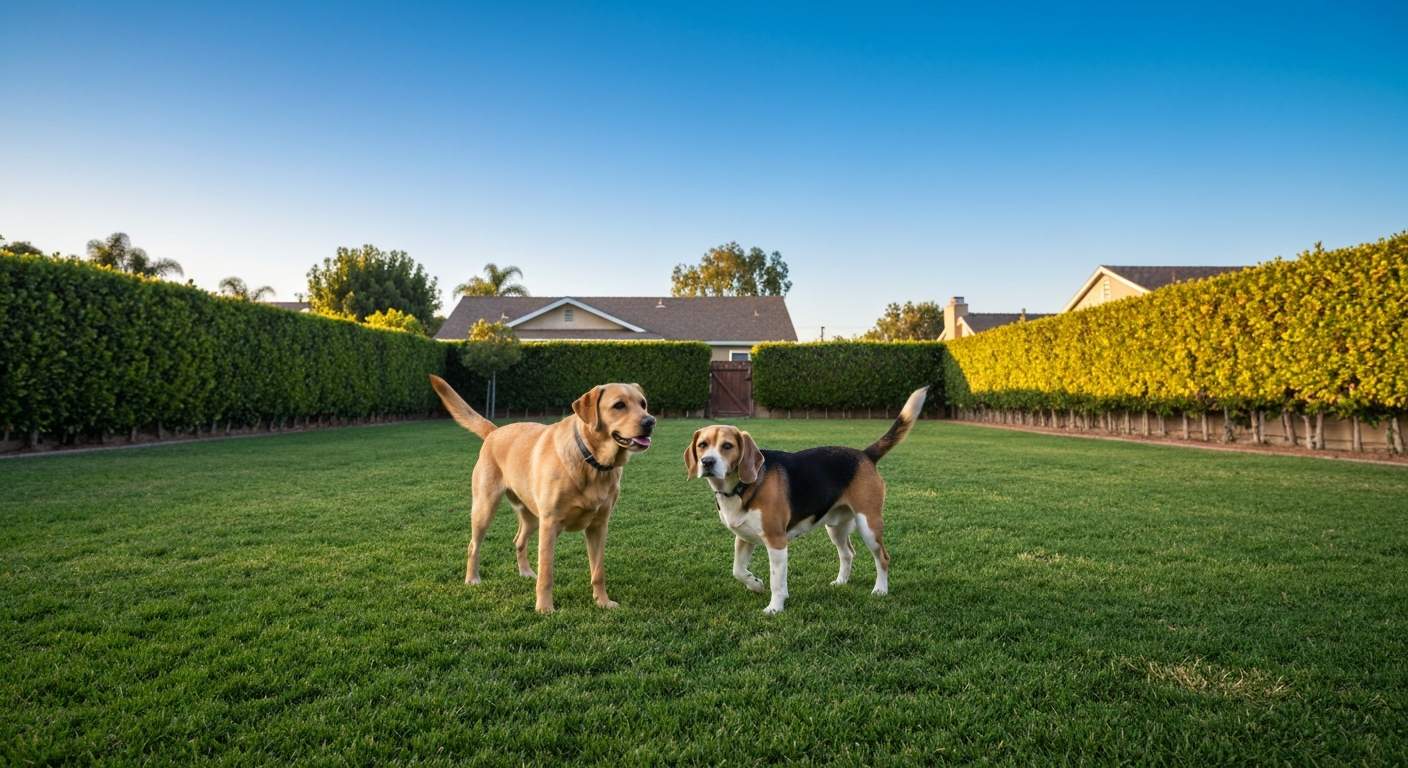
Energy level, how a dog recovers from stimulation, comfort in groups, age, and medical needs all shape which environment fits. A busy commercial floor suits some dogs; a calmer in-home setting suits others; many do best with a mix. The useful step isn't guessing your dog's "type" but comparing the actual environments — group size, noise, structure, and downtime — against what your specific dog needs. Most dogs fall somewhere on that spectrum — and very few owners know exactly where their dog sits until they've tried both.
What to Look For When Comparing Doggy Daycare Near You
Whatever format you're considering, these are the questions that actually tell you what kind of day your dog will have. Use them on tours, calls, and in messages with sitters:
1. How many dogs are present at once, and how are they grouped?
Group size and grouping logic are the single biggest factors in how a day feels for a dog. A facility with 60 dogs split by size and temperament can be a great fit for a confident, social dog. A facility with 60 dogs running together in one yard regardless of size is a different — and riskier — proposition. An in-home sitter with a small number of dogs at a time creates yet another kind of day.
Ask for actual numbers, not averages. "How many dogs do you typically have on a Tuesday?" gets a more useful answer than "What's your capacity?"
2. How is the day structured?
Many pet parents assume "daycare" means non-stop play. Most well-run operations — commercial and in-home — actually run a structured day with rest periods, feeding times, and stimulation breaks. Dogs who play hard all day with no downtime often come home wired and exhausted in unhealthy ways.
A clear, articulated daily routine is a good sign. So is a sitter or staff member who can describe what your specific dog's day would look like, not just the general program.
3. What happens when a dog gets overstimulated or tired?
This is one of the most useful questions you can ask, and the answer is revealing. Operations with a real plan — separate quiet rooms, crate breaks, one-on-one time, optional shifts to a calmer space — are paying attention to the actual experience dogs are having. Operations that don't have a clear answer are usually running on energy management rather than individual care.
4. How will you hear about your dog's day?
Photo updates, written notes, video clips, end-of-day debriefs — there's no universal standard for what's "enough." But there is a clear difference between operations that proactively communicate and those that wait to be asked. For first-time daycare experiences, more communication is almost always better.
5. What's the protocol if your dog isn't a fit?
A daycare environment that's right for many dogs may not be right for yours. Honest operations have a clear process: a meet-and-greet, a half-day trial, and a willingness to say "this isn't the right setup for your dog" if it isn't. Be cautious of any place that doesn't trial new dogs before booking longer days.
6. What does the physical environment look like?
For OC pet parents, this matters more than in many other regions. Specifically:
- Is outdoor space fully fenced? Coyote activity is real in Irvine, South OC, and Wildomar.
- Is there air conditioning available? Summer heat in Orange County makes outdoor-only daycare a real concern from June through September. Hot pavement and heatstroke risk are part of the local picture.
- How clean does it actually look on a normal day, not the day of your tour?
A calm, clean environment with a clear structure is one of the clearest signs of quality care, and it's worth looking for no matter which format you're considering.
How Doggy Daycare Pricing Works in Orange County
OC daycare pricing varies more than it should for what's often the same service. As of 2026, the general ranges look like this:
- Commercial daycare (full day): $40-$65 in Irvine, Costa Mesa, and Newport Beach; $35-$55 in South OC; $30-$45 further inland in Wildomar / Temecula Valley.
- Half-day rates: Typically 60-70% of the full-day rate.
- In-home daycare: $40-$75/day depending on the sitter, location, and number of dogs in care at once.
- Drop-in / walk visits: $25-$45 per visit, with longer visits at the higher end.
Multi-day packages, monthly memberships, and multi-dog discounts are common at commercial facilities. In-home sitters more often work on per-day pricing, sometimes with optional extras (such as extra walks or photo updates) that vary by the individual sitter.
The headline rate isn't always the comparison that matters. A $40 daycare day with 50+ dogs is a very different value calculation than a $55 day in a quiet home with just a few dogs. Both can be the right call — but they're not equivalent.
When Doggy Daycare Is the Right Fit (And When It Isn't)
Daycare is genuinely great for some dogs and not great for others. The honest framing:
Daycare often works well for:
- High-energy adolescent and young adult dogs who need structured stimulation
- Dogs who genuinely enjoy other dogs (different from "tolerates other dogs")
- Dogs whose owners work long hours and would otherwise spend most of the day alone
- Social, confident dogs who recover well from busy environments
Daycare often works less well for:
- Anxious, reactive, or selective dogs who don't enjoy group settings
- Senior dogs — depending on the setting; comparing noise level, group size, and available downtime against your dog's needs matters more than the format itself.
- Dogs recovering from illness, surgery, or major life changes
- Dogs who tend to get overstimulated and struggle to settle afterward
- Dogs who don't have a great history with mixed-size or mixed-temperament play
If your dog doesn't fit the first list cleanly, it's worth comparing calmer, lower-dog-count options — an in-home daycare arrangement, a midday walk, or a private setting — against a higher-volume commercial environment, and choosing based on how your individual dog actually responds. The importance of routine and structured care is especially important for dogs in the second category.
How In-Home Daycare Compares to Commercial Daycare Near You
The clearest way to think about this is to compare environments side-by-side, not by category but by what dogs actually experience:
| Factor | Commercial Facility | In-Home Daycare | |--------|---------------------|-----------------| | Dog count | 20-100+ depending on facility | Far fewer than a facility | | Environment | Purpose-built or converted commercial space | Residential home | | Noise level | High (especially during group play) | Low to moderate | | Individual attention | Limited; shared across many dogs | High | | Structure | Scheduled play / rest blocks | Flexible, often matched to your dog | | Best for | Depends on the individual dog — compare group size, noise, and structure against your dog's needs | Depends on the individual dog — compare the home setting, group size, and one-on-one attention against your dog's needs | | Outdoor space | Often shared yards or runs | Private backyard, fully fenced | | Communication | Daily report cards (sometimes) | Direct messages with the sitter | | Pricing | $30-$65/day | $40-$75/day |
For a related comparison framed around boarding (which often overlaps with daycare for OC pet parents), kennel vs. in-home boarding walks through similar tradeoffs. The same logic applies on a smaller scale to daycare.
If your dog is small or under 25 pounds, the small dog daycare considerations specific to Orange County are worth reading alongside this guide — size-matched care matters more than most pet parents realize until they see the difference firsthand.
Doggy Daycare Near You by City
A few notes on what searches like "doggy daycare near me" actually surface in each of the OC areas where sitters on Ruh-Roh Retreat are most active:
Irvine. The densest market for both commercial daycare and in-home sitters. Commercial facilities cluster around the business parks and the Spectrum area; in-home sitters are spread across the residential neighborhoods. Irvine pet parents often value flexibility and structured routines — both formats can deliver, but the right format depends on your dog's temperament. For a fuller view of the Irvine landscape, the ultimate guide to dog boarding in Irvine covers many of the same operators in more depth.
Costa Mesa. A growing in-home sitter market, with strong demand for calmer alternatives to large commercial facilities. Newport-adjacent traffic and the local pace of life lean toward more personalized care.
San Juan Capistrano and South OC. Lower commercial daycare density, higher in-home sitter availability per square mile. SJC pet parents often want sitters who understand the local rhythm — coyote awareness, foxtail prevention, hot summer days — rather than a generic large-facility experience.
Wildomar and Temecula Valley. A more rural feel with fewer commercial options. In-home daycare and overnight boarding tend to dominate the local landscape, with sitters who can offer real outdoor space and a quieter setting than what's available closer to the coast.
Frequently Asked Questions
Q: How do I know if my dog will like doggy daycare?
A: The honest answer is: you don't, until you try. Most good operations will offer a meet-and-greet and a half-day trial. Pay attention to how your dog acts at pickup the first time. A dog who comes out relaxed and tired (not overstimulated and wired) is a dog who had a good day. A dog who is shutdown, panting heavily for hours, or unusually reactive afterward is telling you it wasn't the right fit. Trust what your dog is showing you over what the report card says.
Q: How often is doggy daycare too much?
A: For most dogs, 2-4 days per week is plenty. Daily daycare can work for high-energy, highly social dogs, but it can also lead to chronic over-arousal in dogs who don't get enough recovery time. If your dog comes home wired or sleep-deprived rather than calm and tired, scale back.
Q: Is in-home daycare safe?
A: When a sitter is experienced, has appropriate space (fully fenced yard, climate-controlled indoor space), and limits the number of dogs in care at once, in-home daycare is at least as safe as commercial daycare — and often safer for small, senior, or anxious dogs. Ask about the sitter's experience, references, what they do in an emergency, and whether they have backup support. On Ruh-Roh Retreat, sitter profiles include experience details, photos, and reviews from past clients to help with that comparison.
Q: What's the difference between doggy daycare and dog boarding?
A: Daycare is daytime care only — you drop off in the morning and pick up at the end of the workday. Boarding is overnight care, with the dog staying through one or more nights. Many sitters and facilities offer both, often at related prices. Daycare is for dogs whose owners need coverage during the workday. Boarding is for travel or longer absences.
Q: Can I do daycare in the morning and boarding the same night?
A: Often yes — particularly with in-home sitters. A "long daycare" day that transitions into an overnight stay is a common arrangement, especially for pet parents leaving town later in the day. Ask the sitter directly; most are flexible. Pricing usually combines a daycare rate with an overnight rate.
Q: How do I find well-reviewed doggy daycare near me in Orange County?
A: Read reviews on Google Business Profiles, but also dig into how recent the reviews are and whether the owner / sitter responds to feedback. For in-home sitters, profile-based platforms like Ruh-Roh Retreat let you compare experience, photos, dog-counts, and reviews side by side, which tends to give you a more useful picture than a generic search result alone.

Ready to Find Doggy Daycare Near You in Orange County?
The right daycare for your dog isn't always the closest one or the cheapest one. It's the environment that matches who your dog actually is — their energy level, their social comfort, their need for structure, their preference for calm or chaos. For most OC pet parents who try both formats, the answer is some mix: occasional commercial daycare days for high-energy social dogs, and in-home daycare or sitter visits for everything else.
If you're looking for an in-home doggy daycare option near you in Irvine, Costa Mesa, San Juan Capistrano, or Wildomar, browse sitters near you on Ruh-Roh Retreat. You can compare experience, see their actual home environment, read real reviews from local pet parents, and message a sitter directly before booking. The marketplace makes it easier to compare what doggy daycare near you actually looks like — not just what the search results say.
You Might Also Like
 9 min
9 minMay 9, 2026
Small Dog Daycare in Orange County: What Irvine Pet Parents Need to Know
Searching for small dog daycare in Irvine or Orange County? Learn what size-matched care actually looks like, what questions to ask, and how to find the right fit.
Read More → 8 min
8 minJul 4, 2026
How to Book a Dog Sitter Online in Orange County: A Step-by-Step Guide
Learn how to book a dog sitter online in Orange County — from comparing sitters to a meet-and-greet to confirming dates — plus the trust signals worth checking before you commit.
Read More → 10 min
Jun 23, 2026
How Much Does Dog Boarding Cost in Orange County? A 2026 Pricing Guide
Wondering about dog boarding cost in Orange County? Here's what pet parents actually pay in 2026 — in-home vs. kennel pricing, what drives the price, and how to compare rates and book the right sitter.
Read More →