
Boarding Your Rescue Dog for the First Time: What You Need to Know
11 min read
- 1.Why the Boarding Environment Matters So Much for Rescue Dogs
- 2.Understanding Your Rescue Dog's Stress Signals
- 3.What In-Home Boarding Can Offer a Rescue Dog
- 4.How to Prepare Your Rescue Dog for Their First Boarding Stay
- 5.What to Look for in a Sitter for a Rescue Dog
- 6.Frequently Asked Questions
- 7.They've Come This Far — Choose a Stay That Honors That
You adopted a dog who'd been through something. Maybe a shelter. Maybe a difficult past. Maybe they were found as a stray and no one knows what they experienced before they came to you. What you do know is this: they've come a long way. They trust you. They've built a life with you. And now you have to leave for a week.
The prospect of boarding a rescue dog for the first time can feel genuinely alarming. You've worked hard to earn their confidence. Will a boarding stay undo that? Will they shut down? Will the environment trigger something?
These concerns are valid — and they point to something important. Rescue dogs are not the same as dogs who have been in stable homes since puppyhood. Their stress responses are often heightened, their triggers may be unpredictable, and their capacity for coping in unfamiliar environments depends heavily on the quality of that environment. The choice of where and how they board matters more, not less.
Here's what you need to know before you go.
Why the Boarding Environment Matters So Much for Rescue Dogs
Large, high-volume boarding settings can be harder on a dog with a trauma history — though facilities vary widely, so it's worth evaluating any option against your dog's specific needs.
Noise. Larger facilities that house many dogs can be loud and unpredictable, so it's worth asking any provider about noise levels and how many dogs they care for at once. For a dog who has spent time in a chaotic or threatening environment — a neglect situation, an abusive home, a noisy shelter — ambient noise is not just unpleasant. It can be actively triggering. When many dogs are housed together, barking can trigger more barking, and that escalating sound can keep an already-anxious dog in a state of sustained hyperarousal.
Unfamiliar handling. Rescue dogs who have been mistreated or neglected often have complex responses to unfamiliar people — especially people who move quickly, speak loudly, or approach in ways that feel threatening. In a busy setting where staff rotate shifts and have limited time per dog, unfamiliar handling can be harder on a sensitive rescue dog — so ask any provider how much one-on-one time your dog would get and who would be handling them.
Confined spaces. For a rescue dog with shelter history, a kennel-run setup may echo the environment they came from. If that's a concern for your dog, look for a setting that feels less like confinement. For a dog who has worked hard to overcome confinement anxiety, a week back in a run can be a significant setback.
Social exposure without control. Some facilities use group play yards that introduce dogs to animals they've never met. For a dog with fear-based reactivity or an uncertain dog-dog history, group play can be frightening rather than enriching — so ask any provider how they manage, or avoid, group interactions.
None of this means rescue dogs can't be boarded. It means the environment they board in matters enormously.
Understanding Your Rescue Dog's Stress Signals
Before you board your dog anywhere, it's worth having a clear picture of how they express stress. Rescue dogs — especially those who spent time in shelters — often learned to suppress outward signs of distress because vocalizing didn't get their needs met. This makes them harder to read.
Common stress signals in rescue dogs that can go unnoticed:
Subtle early signals:
- Yawning outside of tired contexts
- Lip licking without food present
- Turning the head or body away
- Blinking repeatedly or squinting
- A tucked tail even when otherwise behaving normally
Escalating signals:
- Panting beyond what exercise or heat explains
- Pacing or inability to settle
- Scanning the room rather than relaxing
- Hyper-attachment or shadow behavior
Shutdown (often misread as "calm"):
- Stillness that looks like relaxed but isn't
- Lowered head, ears back, tail hanging
- Refusing food (in a dog who is normally food-motivated)
- Reduced eye contact or glazed expression
Knowing your dog's specific signals allows you to communicate them clearly to a sitter — and lets the sitter recognize whether your dog is genuinely settled or just suppressing. If your dog has shown signs of separation anxiety at home, recognizing those signs early matters just as much in a boarding context.
What In-Home Boarding Can Offer a Rescue Dog
The characteristics of in-home boarding address much of what can make a large facility harder for some rescue dogs.
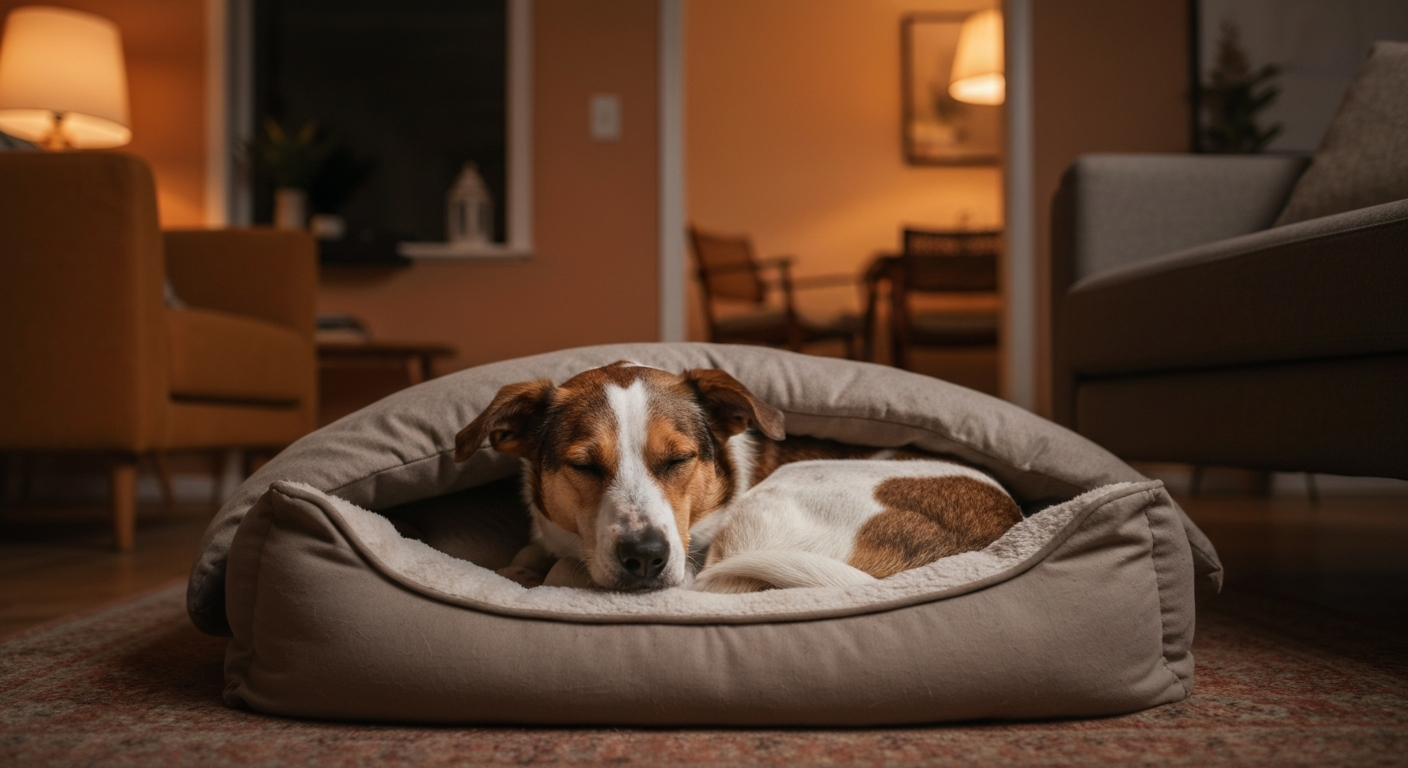
A home environment. This sounds simple, but it's profound for a dog who has been rehabilitated in a home setting. The sounds of a household — refrigerator hum, television, ambient quiet — are familiar and safe. They signal domestic life — the everyday sounds of a home rather than an institutional setting. A rescue dog who has worked hard to trust a home environment may find a different home setting familiar enough to settle into more readily.
One consistent person. An independent in-home sitter is typically the only person your dog interacts with for the duration of the stay (plus any household members you've been informed about). Your dog can attach to one handler and find their footing — which is exactly what dogs with insecure attachment histories need. In Orange County, where the rescue community is active and many adopters are navigating exactly this transition, this kind of individualized care is increasingly what rescue-savvy pet parents seek out.
Quiet and predictable. A private home with a small number of guest dogs offers a quieter, more predictable setting. For a rescue dog whose nervous system runs hot, the sensory difference between a quiet home and a busy multi-dog setting can be significant — which is exactly why matching the environment to your individual dog matters.
Flexible and responsive care. When you board with an independent sitter, you can communicate your dog's needs in detail — their specific triggers, their stress signals, what calms them, what their safe routines look like. A thoughtful sitter will follow this guidance throughout the stay. Understanding the importance of that daily structure helps clarify why maintaining routine is especially critical for dogs with anxiety histories.
How to Prepare Your Rescue Dog for Their First Boarding Stay
Preparation matters. A rescue dog thrown into a new environment without any prior exposure will have a harder time than one who has been gradually introduced to the concept of temporary transitions.
Do a trial visit before the full stay. If your dog will be staying with an in-home sitter, ask if you can do a 2-3 hour visit first. Let your dog explore the space, meet the sitter, and return home with you. This gives them a positive first association before you're actually gone.
Build toward overnight. If possible before a longer trip, do a short overnight stay first. One night is much easier to recover from than seven — and gives you real data about how your dog actually does in that environment.
Bring their comfort items. A piece of worn clothing with your scent can be genuinely settling for an anxious dog. Their own bed or blanket provides familiar sensory input. A favorite chew or toy gives them something to do with stress-related energy.
Write a clear behavioral profile. Don't just share the basics. Tell the sitter about your dog's history as you know it, their specific triggers, their stress signals, what works to calm them, and what doesn't. The more context the sitter has, the better they can manage the stay. The full pre-boarding checklist is a useful template for organizing everything worth communicating.
Set up a communication plan. Ask the sitter how they'll update you — frequency, format, what to expect. For the first stay especially, daily updates with a photo or short video can help you gauge how your dog is actually doing rather than anxiously wondering.
What to Look for in a Sitter for a Rescue Dog
Not every sitter is the right fit for every dog. When you're placing a rescue dog with complex needs, a few qualities matter more than usual:
They ask good questions. A sitter who wants to understand your dog's history, triggers, and behavioral patterns before committing to the stay is one who takes their responsibility seriously. Vague reassurances ("I love all dogs, it'll be fine!") are less meaningful than genuine curiosity about your specific dog.
They have experience with anxious or reactive dogs. This doesn't mean they need a professional behavior credential — but some experience with dogs who require more patience and awareness is valuable. Ask how they handle a dog who shuts down or is slow to warm up.
They have a calm, predictable home. A household with very young children, a lot of foot traffic, or other animals that could be stressful for your dog may not be the right fit. Ask about their household composition and typical daily environment.
They communicate proactively. For a rescue dog's first stay, you want a sitter who updates you without being prompted. Not just when something goes wrong — but routine check-ins that show the dog is settling.
They're honest. If your dog is struggling during the stay, you want to know. A sitter who will tell you "she's had a hard first day but is starting to relax" is infinitely more valuable than one who tells you everything is great when it isn't.
Frequently Asked Questions
Q: What if my rescue dog has never been separated from me overnight? A: This makes preparation even more important. Do one or more daytime trial visits with the sitter before the full stay. Practice short separations at home — stepping out for an hour, building to longer absences. For dogs with severe separation distress, a consultation with a certified applied animal behaviorist before the first boarding stay can be worth the investment.
Q: My rescue dog has bitten before. Can they still board? A: Potentially yes, with the right sitter who is fully informed and experienced. You must disclose bite history — both ethically and, in many states, legally. Some sitters specialize in working with dogs who have fear-based aggression and will accept them with appropriate protocols in place. Do not withhold this information hoping the stay will go fine.
Q: Should I tell the sitter everything about my dog's history, even if it's bad? A: Yes. Full disclosure protects your dog, the sitter, and any other animals or people in the home. A sitter who agrees to care for your dog after knowing the full picture is far better positioned to do that job well than one who gets surprised mid-stay.
Q: My dog has been doing great — do I really need to worry? A: Progress made in a stable home environment doesn't automatically transfer to new environments. Many dogs regress somewhat in their first few boarding experiences before becoming more resilient. This isn't failure — it's normal. Choosing the right environment and setting realistic expectations makes the experience better for both of you.
They've Come This Far — Choose a Stay That Honors That
Your rescue dog has done something remarkable. They've learned to trust again, build a routine, and feel safe. Boarding them for the first time doesn't have to undo any of that — not if the environment is right.
Browse sitters on Ruh-Roh Retreat and find an independent provider in Orange County whose home, experience, and approach are the right fit for a dog who deserves to be understood, not just managed. Many platforms make it easy to find a sitter; Ruh-Roh Retreat makes it easier to find the right one — a curated marketplace where you can compare experienced sitters by home environment, experience, and care style to choose the fit for your individual dog.
If you're a rescue organization sharing this with adopters: feel free to use this as a resource in your post-adoption packet. The more an adopter understands about why environment matters during boarding, the better choices they'll make — for the dog and for the progress you've both worked toward.
You Might Also Like
 10 min
Jun 23, 2026
How Much Does Dog Boarding Cost in Orange County? A 2026 Pricing Guide
Wondering about dog boarding cost in Orange County? Here's what pet parents actually pay in 2026 — in-home vs. kennel pricing, what drives the price, and how to compare rates and book the right sitter.
Read More → 11 min
Jun 6, 2026
Dog Boarding in Tustin, CA: What Pet Parents Need to Know in 2026
Looking for dog boarding in Tustin, CA? Learn why local pet parents choose in-home boarding, what to ask before you book, how pricing works, and how Tustin's proximity to Irvine widens your sitter options.
Read More → 12 min
May 16, 2026
The Ultimate Guide to Dog Boarding in Irvine, CA (2026 Edition)
Looking for dog boarding in Irvine, CA? This comprehensive guide covers your options, what to ask before booking, how pricing works, and why in-home boarding fits Irvine pet parents particularly well.
Read More →